When winter rolls into Minnesota, large commercial facilities face a unique challenge: warehouse heating that keeps employees comfortable, protects inventory, and doesn’t drain the budget. High ceilings, open floor plans, and constant loading dock traffic mean heat can escape quickly—especially during sub-zero stretches.
If you operate a warehouse, distribution center, or light-manufacturing facility in the Twin Cities, choosing the right heating system isn’t just a comfort decision—it’s a profitability decision.
Below, we break down three of the most common systems we install across Minnesota facilities: unit heaters, radiant tube heaters, and make-up air heaters. By understanding the differences, you’ll be better equipped to choose a system that fits your building, budget, and operational needs.
1. Unit Heaters
If you’ve stepped into a warehouse in the past 30 years, chances are you’ve seen large unit heaters mounted near the ceiling—often fired by natural gas. These compact systems pull air across a heat exchanger and push warm air into the space using a fan.
Advantages
- Cost-effective upfront
- Easy to install in most warehouse layouts
- Quick heat recovery after dock doors open
- Familiar and widely serviced
Ideal Applications
- High-traffic warehouses with frequent air infiltration
- Facilities that need targeted zone heating
- Buildings needing quick heat delivery
Considerations
- Heat rises—so stratification can waste energy without proper air movement
- Can create hot and cold spots
- Not always ideal for tall-ceiling buildings without destratification fans
Bottom Line
Unit heaters are functional and reliable—but not always the most energy-efficient long-term solution for warehouse heating without airflow optimization.
2. Radiant Tube Heaters
Rather than heating the air, industrial radiant heat warms the objects and people directly below the heater—similar to the sun warming the ground. Radiant tube heaters are mounted overhead and use infrared energy to radiate heat downward.
Advantages
- Significant energy savings in tall or drafty buildings
- Heat stays in the occupied zone—not trapped at the ceiling
- Minimal air movement reduces dust and airborne particles
- Quiet operation
- Excellent for employee work zones or loading areas
Best Applications
- Warehouses with racking that blocks airflow
- Loading docks and manufacturing floors
- Cold-storage facilities with temperature-critical products
Considerations
- Requires professional layout design to avoid cold shadows
- No built-in fresh air delivery
- Higher initial investment than unit heaters
Bottom Line
If efficiency and occupant comfort are priorities, industrial radiant heat tubing is one of the smartest investments in Minnesota’s climate.
3. Make-Up Air Heaters
Warehouses constantly pull in cold air through ventilation, exhaust fans, and open dock doors. A make-up air heater prevents negative building pressure by bringing in and heating outdoor air before it enters the space. This ensures proper ventilation, code compliance, and better indoor air quality.
Advantages
- Replaces lost air to maintain pressure balance
- Helps meet safety and ventilation requirements
- Reduces cold drafts from infiltration
- Can serve as a primary heat source in some facilities
Best Applications
- Manufacturing with exhaust systems
- Buildings with high occupant turnover
- Cold-storage vestibules and large-door zones
- Facilities experiencing doors “sucking closed” due to pressure issues
Considerations
- Higher energy use when outdoor temperatures are extreme
- Often paired with unit or radiant heaters for best results
Bottom Line
Great for ventilation control—often essential in busy dock environments—but rarely a standalone solution for full warehouse heating.
Which Heating System Is Right for Your Facility?
To help simplify the comparison, here’s a quick breakdown:
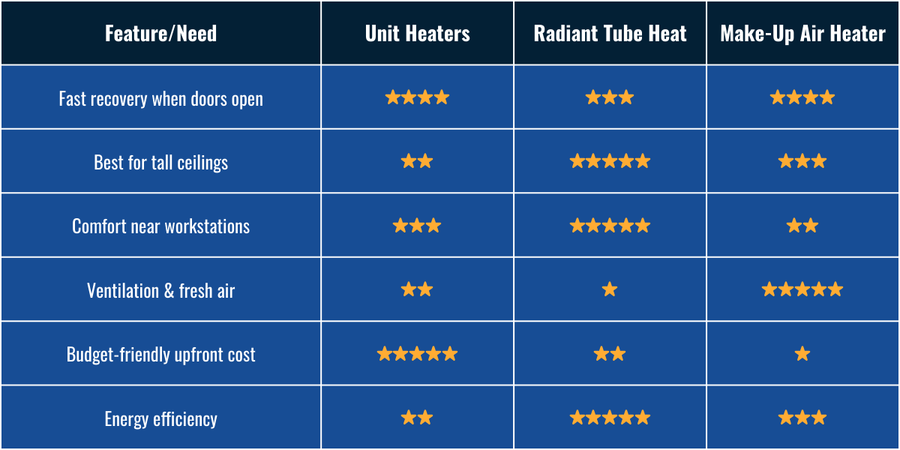
Most Minnesota warehouses end up with a hybrid solution—adding radiant heat in work areas, while unit heaters cover open zones, and make-up air heaters support ventilation. Because no two warehouse operations are alike, system design is everything.
Upgrading for Better Efficiency—Why Now?
Replacing outdated or oversized equipment can reduce heating spend by 20–50%, especially in large buildings where energy is a major operating cost.
Modern systems offer:
- Smart controls and zoning strategies
- High-efficiency burners
- Better air destratification and comfort
- Faster payback through energy savings
And if rebates or commercial incentives are available, timing upgrades before winter begins is even more valuable.
Don’t Skip Preventive Maintenance
Minnesota winters aren’t forgiving, and breakdowns at the wrong moment can be costly. Whether you choose unit heaters, radiant heat, or a make-up air heater, commercial HVAC servicing is critical for safety and longevity.
Routine maintenance helps prevent:
- Cracked heat exchangers (safety hazard!)
- Frozen components
- High CO levels
- Expensive emergency repairs
Binder offers commercial service plans and seasonal tune-ups designed for warehouses, keeping your operation running 24/7/365—without disruption.
Let’s Design a Smarter Warehouse Heating Solution
Whether you’re comparing unit heater vs radiant options for the first time or looking to optimize a system you already have, our commercial heating experts are ready to help.
We’ll assess your:
✔ Building layout & ceiling height
✔ Equipment age & condition
✔ Ventilation and infiltration patterns
✔ Inventory & occupant comfort needs
Our team will give you honest recommendations, cost-effective options, and a long-term strategy to keep your building warm without blowing your budget.
Give us a call or request service online today. Your warehouse deserves heating that works as hard as you do—especially in a Minnesota winter.