When planning a commercial kitchen—whether for a restaurant, school, or hospitality space—ventilation isn’t just another line item. It’s the backbone of the operation.
Proper commercial kitchen ventilation protects your staff, keeps customers comfortable, prevents fire hazards, and ensures your space passes inspection. And in Minnesota, where heating costs and code requirements both matter, getting it right the first time is critical.
At Binder Heat & Air, commercial kitchen projects are some of our favorite work. From new construction builds to challenging retrofits, we help businesses design and install systems that meet code, operate efficiently, and hold up to whatever your kitchen staff can throw at them.
Here’s how commercial kitchen ventilation systems all fit together.
Step 1: Understanding the Code
Before equipment is selected or ductwork is run, code compliance drives the design.
Most commercial kitchens that produce grease-laden vapors are required to install an NFPA 96 hood. NFPA 96 is the national standard for fire protection of commercial cooking operations. It governs:
- Hood construction
- Grease duct design
- Fire suppression systems
- Exhaust fan requirements
- Clearance and fire ratings
And if your kitchen includes fryers, grills, charbroilers, ranges, or woks, you almost certainly need a Type I grease hood system.
Failing to meet these requirements can result in failed inspections, fire risks, and insurance complications.
This is where experience matters. Code compliance isn’t optional, and inspectors expect it to be done correctly.
Step 2: The Hood System
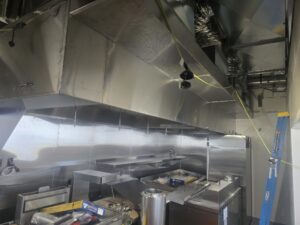
The hood is the visible part of your commercial kitchen ventilation system, but its performance depends on proper sizing and airflow design.
A well-designed hood system must:
- Capture grease vapors at the source
- Prevent smoke from spilling into the kitchen
- Maintain safe exhaust velocities
- Coordinate with fire suppression systems
Undersized hoods lead to smoke escape and greasy surfaces. Oversized systems increase energy costs unnecessarily. At Binder, we work with engineers and project teams to calculate the correct airflow based on equipment type, layout, and cooking volume. Because once the drywall is up, fixing ventilation mistakes becomes very expensive.
When selecting hood systems, we only choose trusted manufacturers such as CaptiveAire and Venpro. These systems are known throughout the industry for their reliability, performance, and code-compliant design. Choosing the right hood manufacturer helps ensure proper grease capture, durable construction, and long-term ventilation performance in demanding commercial kitchen environments.
Step 3: Make-Up Air
Here’s where many commercial ventilation projects go wrong.
Every cubic foot of air exhausted by your hood must be replaced. That’s why most kitchens require a dedicated make-up air unit. A make-up air unit replaces exhausted air with filtered and tempered outdoor air. In Minnesota, that typically means heating incoming air during the winter months.
Without replacement air, the building goes negative. That leads to:
- Slamming or hard-to-open doors
- Cold air infiltration
- Poor hood capture
- Drafty dining rooms
- Higher heating costs
Proper sizing is critical here as well. A kitchen exhausting 4,000–6,000 CFM needs nearly equal replacement air to maintain balance.
When properly designed, the kitchen feels comfortable. When poorly designed, everyone notices.
Step 4: Heat Recovery
Commercial kitchens exhaust massive amounts of heated air during winter. Without heat recovery, you’re essentially heating outdoor air and immediately throwing it away.
Modern systems can capture energy from exhaust air and transfer it to incoming make-up air.
Benefits include:
- Reduced heating costs
- Improved system efficiency
- Lower utility bills
- Better sustainability
In Minnesota’s climate, heat recovery isn’t just a luxury—it’s often a smart financial decision, especially for high-hour operations.
Step 5: New Construction vs. Retrofit Projects
New Kitchen Builds
When ventilation is planned early, the results are much better.
New construction allows:
- Efficient duct routing
- Proper shaft design
- Optimized equipment sizing
- Integrated heat recovery
At Binder, we enjoy collaborating early in the design process because it prevents costly redesigns later.
Retrofitting an Existing Kitchen
Retrofitting is more complex—and more common.
Older buildings often present:
- Limited ceiling space
- Structural obstacles
- Undersized electrical systems
- Outdated ductwork
These projects require experience and problem-solving in the field. This is where our in-house sheet metal fabrication shop becomes a major advantage. Custom duct solutions allow us to navigate tight spaces without compromising performance.
Step 6: Grease Fan Maintenance
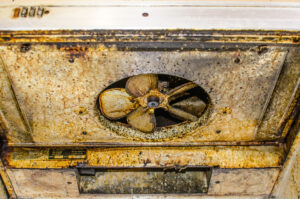
Installation is only part of the equation.
Grease buildup can reduce fan efficiency and increase fire risk. Regular maintenance keeps your ventilation system operating the way it was designed to.
Routine grease fan maintenance should include:
- Motor and belt inspection
- Fan blade cleaning checks
- Bearing lubrication
- Airflow testing
- Vibration checks
6 Signs Your Commercial Kitchen Ventilation Needs Attention
If you notice:
- Smoke escaping the hood
- Excessive kitchen heat
- Greasy residue buildup
- Strong lingering odors
- Loud or vibrating exhaust fans
- Rising utility costs
It may be time for inspection, repair, or system upgrades. Ignoring these warning signs can lead to bigger problems—and expensive downtime. Contact us right away if you spot one or more of these issues.
Let’s Design It Right the First Time
Commercial kitchen ventilation isn’t something you want to redo. If you’re planning a new kitchen, remodeling an existing space, or struggling with ventilation performance, we’re ready to help.
Binder has decades of experience in complex commercial kitchen ventilation installations. We understand the inspection process. We understand Minnesota’s unpredictable climate. And we understand how to design systems that work—not just pass inspections.
We’ve had the opportunity to work on several well-known restaurant kitchens throughout the Twin Cities, including:
- Tono Pizzeria & Cheesesteaks
- Giordano’s Minneapolis/Richfield
- Boca Chica Restaurante y Cantina
- Centro Twin Cities
- Cedar Inn Bar & Grill
Projects like these require careful coordination between contractors, inspectors, and restaurant owners to ensure ventilation systems are installed correctly and pass inspection the first time. Whether you’re retrofitting an older space or building a new commercial kitchen from the ground up, our team can guide the entire ventilation process.
Learn more about our custom commercial HVAC services or request a consultation today.